The making of “Domaine et Terroir” – behind the scenes
The invitation to exhibit at Domaine Henri Ruppert arose from a chance meeting: an employee of the winery, delivering crémant to another event where Morag Paul was exhibiting, asked if she might be interested in showing her work at the Domaine. Always drawn to new locations as inspiration for her watercolours, Morag immediately saw the opportunity for a fresh artistic project. Rather than simply showing existing works, she planned to create a series of paintings based on time spent in and around the winery. This approach stems directly from her desire to engage fully with the beauty of the surrounding landscape, transforming it into art. To achieve complete authenticity, her work emerges from direct experience rather than photographs or memory.
Meeting the Ruppert family and their employees and witnessing their work firsthand proved an enriching experience, whether outdoors in the vineyard, within the largely unseen “belly” of the building, or observing the business side of producing and selling fine wines. There is much to learn from listening to experts tasting and discussing wines in the language of true connoisseurs.
Central to the exhibition is, of course, the spectacular building designed by the renowned Luxembourg architect François Valentiny, now home to Domaine Henri Ruppert. The exhibition’s subtitle, “A Dialogue Between Architecture and the Land,” pays tribute to the way the building merges with its surroundings: it is very much part of the land and impossible to overlook. Built for Henri Ruppert, the winery was completed in 2008. According to the architect, its design reflects the quality of the wines, while also meeting the strict requirements of modern winemaking.
“The design allows the grapes to be handled gently — no pumps, only gravity. The functional zones of the cellar are arranged vertically: at the top, the grapes are delivered and fall to be crushed, followed by the winepress, first fermentation in tanks, barrel storage, bottling, and finally dispatch. The new winegrower’s house sits amidst the vineyards: the winery is embedded in the earth, while the dwelling above emerges organically, its roof extending the vineyard’s vegetation. The façade uses the traditional coarse regional render, giving the impression of rock. Spatially, the dwelling and outbuildings form a courtyard open to the Moselle Valley above the winery itself. A pool, also used for swimming, cools the barrel storage below. From the tasting room, one can view not only the valley but also the barrique cellar.”
— ValentinyArchitects.com
Morag was captivated by how the building flows into the landscape, as well as by the surrounding scenery. Already familiar with viticulture from her series “The Mosel and Its Wine Villages,” she drew inspiration from rows of vines, patchwork of vineyards, wooded hilltops, and the picturesque villages of the Luxembourg Route du Vin forming a vibrant backdrop. Through it all, the majestic Moselle flows mirroring the changing moods of the seasons. Observing the daily life on the Domaine — the comings and goings of various family friends, visitors to the wine tavern, and dog walkers on the Markusberg — gave Morag a unique insight into life in and around the winery.
All paintings in the Domaine et Terroir series were completed within a relatively short window, between February and April. This presented challenges: a particularly wet February often made plein air work impossible. It was also crucial to the artist to depict the land awakening into spring. With persistently cold temperatures, this transformation was slow, yet a complete exhibition had to be ready for its opening on 24 April 2026.
Despite these challenges, the experience proved to be deeply inspiring. Morag is deeply grateful to Henri Ruppert for making this artistic project possible and for the enriching experience of painting in and around the Domaine in spring 2026.
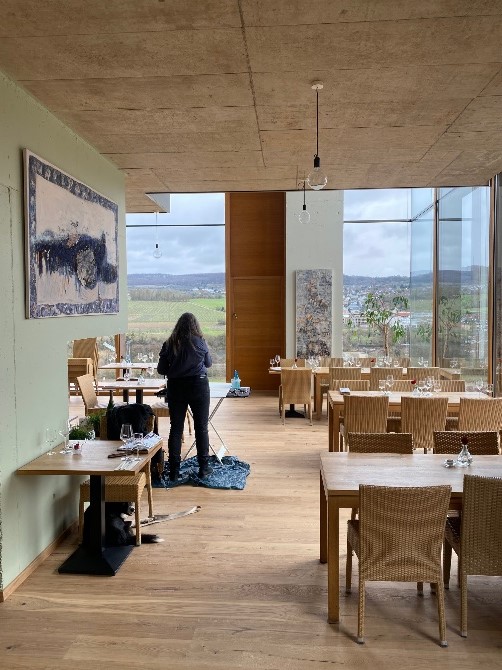
Painting the view from the window on a cold, showery day in February.
Set-up for painting “The Building Arches over the Land in the First Warmth of Spring”
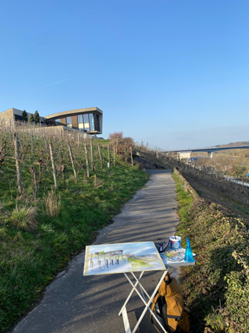
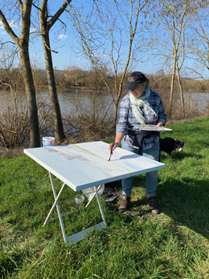
Painting the winery from across the Mosel on a warm spring day.
To switch to another language please follow these links Deutsch & Français.
<- Back to the previous chapter Individual Painting Descriptions
On to the next chapter About the artist ->